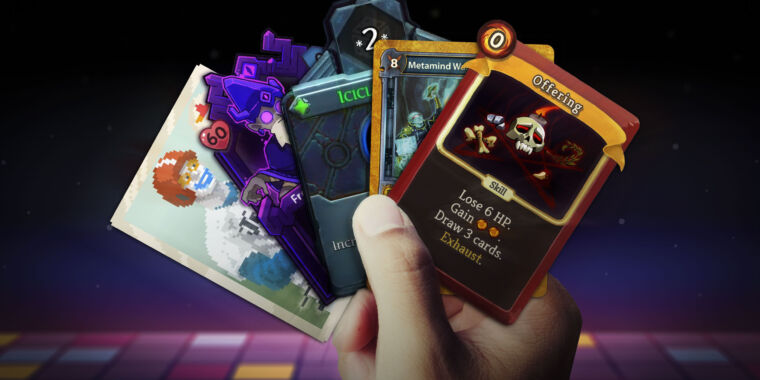
I don’t think we need an article to figure out the answer: Slay the Spire was a megahit and it’s a copycat industry.
I don’t necessarily mean that in a bad way either; there’re always plenty of devs finding interesting new angles on the current hot genre and creating genuinely interesting new games in the process, but also a huge number of devs that end up just chasing the trend and releasing something uninspired/derivative.
The genre can be called “rogue like deck builder” all you want, we all know what it really is: “Spirelike”
I really think it deserves its own genre. Games like Cobalt Core, Balatro, Tower Tactics Liberation, Alina of the Arena and Loop Hero are all unique in their own right and differ greatly in gameplay from Slay the Spire and each other but still hold to the deck building rogue-like core.
Slay the spire is the granddaddy of the genre, but isn’t the single defining example by far.
Right but Rogue isn’t much like modern Roguelikes either. It’s still the genre.
I think the “rogue” in rogue-like refers to the fact that you start over if you die. Not the similarity to the actual game. Am I misunderstanding you?
I think I get what you’re saying, that rogue-like was named after the game and therefore this genre should be named after slay the spire. But I think Rogue named the genre because there wasn’t anything else like it. Slay the Spire is still at the end of the day a mashup of two existing genres.
Rogue was the start of the genre - games that came after we’re always measured against it.
Rogue was a dungeon crawler - a type of game that had been done plenty of times before. Starting over on death had also been done.
But it became genre defining by being the best at both.
Spire I’d say is similar. It is genre defining because the combination of gameplay elements was so perfectly executed that it will become the measuring stick against which all roguelike deck builders will be measured. So Spirelike fits, I think.
It’s not even an original concept. It’s just the popular kid.
deleted by creator
It’s even easier than that. Both of these genres have design features that require minimal balancing, making for an even faster dev cycle.
Roguelikes side-step the need for traditional game balance by providing meta progression and building inevitable-death-by-impossible-odds into the core game. For Roguelikes that actually have an ending, all the developer needs to do is provide enough meta progression perks to overcome the game’s peak difficulty, for even the worst of players. Everyone else gets bragging rights for beating the game faster than that. Either way, the lack of balance and “fairness” in the core design are features, not flaws.
Deck builders follow in Magic The Gathering’s footsteps: you never need to fully balance it. Ever. The random draw mechanisms, combined with a deep inventory of resource and item/creature/action cards, make it unlikely that a player gets an overpowered hand all the time. Pepper a few ridiculously overpowered cards in there, and it just feels more fun. Plus, if you keep the gravy train going with regular add-ons, the lack of balance is even further masked by all the possible choices. And yes, some player will min/max a deck at great personal expense and wipe the floor with their opponents because it was never fair in the first place, and doing so is a feature.
Of all the indie game trends this one is probably my favorite. Feels like a resurgence of awesome card game RPGs that were really rare back in the day
I was for it for the first 100 clones. Now it’s in the same vein as 2d pixel shooter rougelikes, way too saturated. I never give these a second look because there’s just so many uninspired clones.
All these games and only one of them (Balatro) is even worth playing
My most played Steam game is Dishonored, at 127 hours. I have replayed it a lot. A rarity for me, but I really liked that game. Dishonored came out in 2012. It’s taken me 12 years to accumulate that many hours.
Balatro came out two months ago.
I have 93 hours in it.
I’ve really enjoyed Slay the Spire, Inscryption, Dicey Dungeons, Monster Train, Balatro, Peglin, Hellcard, and Banners of Ruin from this genre.
Slay the Spire is fun (but has aged). Luck be a Landlord is great fun too. And of course the Meteorfall series. All have a slightly different gameplay, but they’re all worth their money.
That said, I (just a casual gamer) learned about Balatro yesterday so am just a couple of hours in to it and must agree it is a blast, too!
Luck be a Landlord was my favorite out if all, Balatro might beat that but I need more hours and exploration.
Can anyone recommend one? I honestly haven’t played one since slay the spire, and loved it. My wife didn’t enjoy the music after a few hundred hours so I stopped playing a few years ago.
Everyone and their mother is playing Balatro, and for good reason. Super fun deck builder based on a normal playing card deck and poker hands. Great music and visuals, too.
Also, check out Inscryption. Truth be told, it’s not really a true roguelike deckbuilder, rather it uses the genre as a storytelling medium. Still, really fun game with solid core gameplay and an engaging story. There’s also DLC that lets you play more of the deckbuilder part indefinitely.
To anyone reading this - if you try Inscription, go in blind.
I’ve played Wildfrost, but I don’t feel confident in recommending it, because it’s quite hard and very RNG-based. But, maybe that’s your thing. Honestly, I played it just for the art style lol
Monster train is phenomenal.
It combines tower defense elements and multi deck selections for crazy replayabiity.
It, and as someone else said, balatro, are my 2 favorites since slay the spire.
You know you can turn off the music, right? Just play your own or none at all.
The music in slay the spire is perfectly fine but it gets repetitive after a while. But it’s also a great game to play while listening to podcasts so it’s a non issue
I had a lot of fun with Cobalt Core. Much more lighthearted; great soundtrack too.